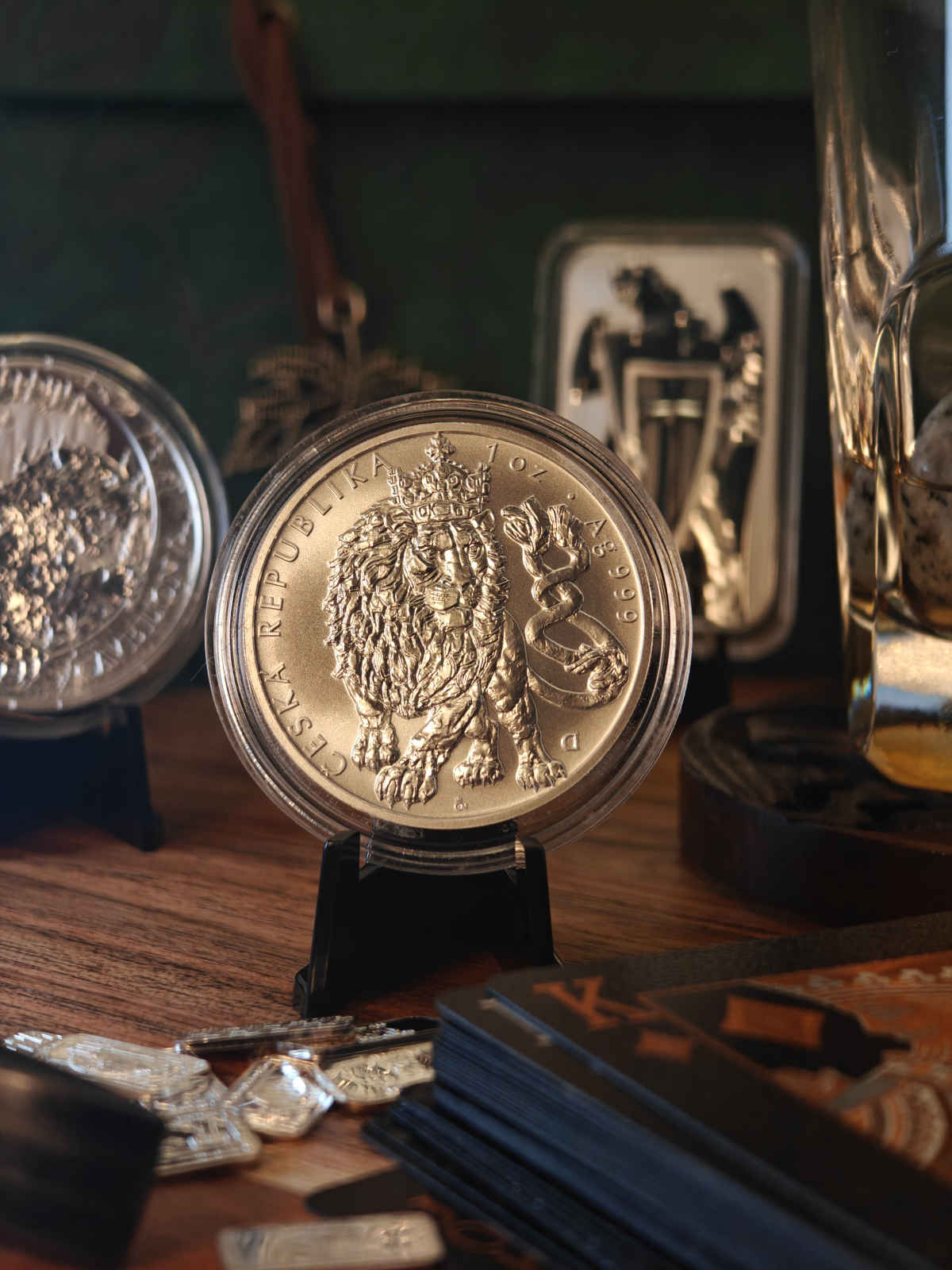
Guide
Seller guide for relatives
A guide for the family. One day a collection changes hands, and the person holding it usually knows less about it than the person who built it. This page explains what the pieces are, what they are actually worth, and how to sell them without being taken advantage of.
If you are the stacker: download this guide, print it, and keep it with your collection. It says the things you would want said when you are not the one saying them.
Last updated: July 20, 2026
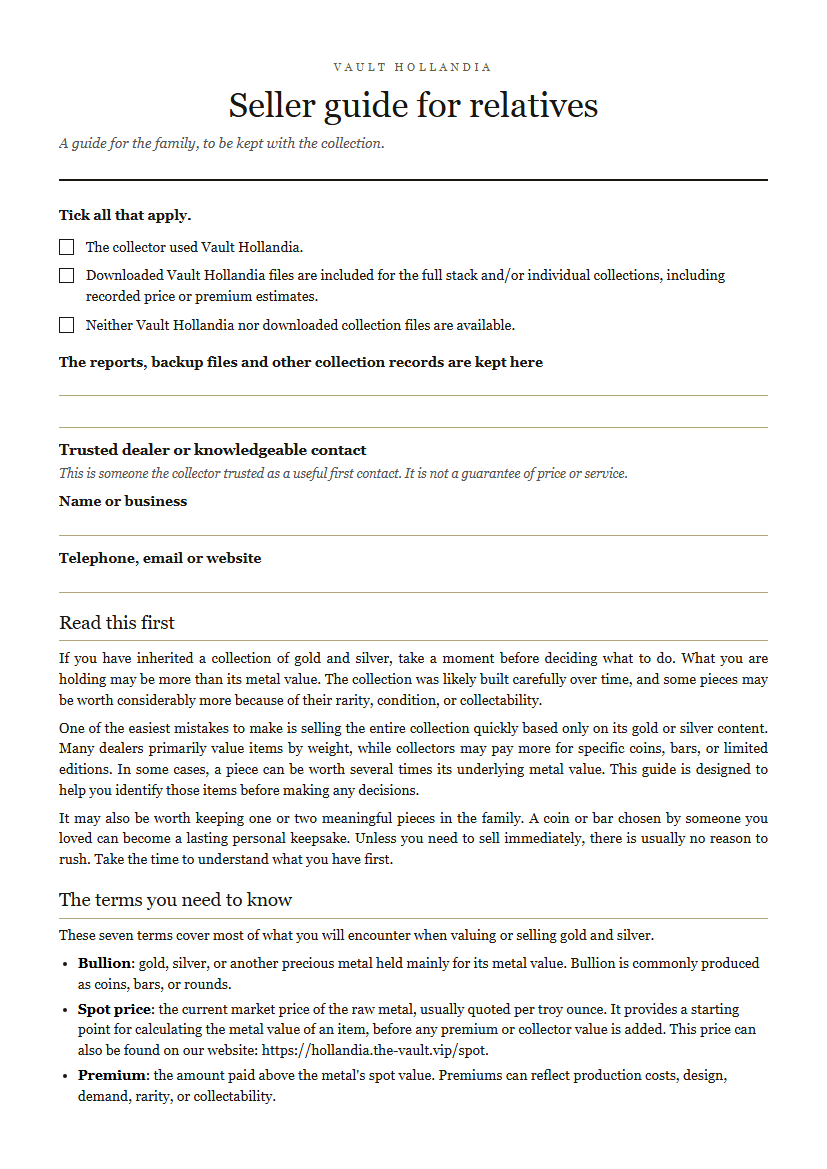
What this is: a few printed pages, no login and no app required to read it. Click the page to read the whole guide full size.
Tell your family where it is. A guide nobody can find helps nobody. Name the drawer holding the printed copy, or the folder holding the file, and tell at least one person you trust.
It works alongside your vault. If you use Vault Hollandia, keep an exported backup with the printed guide. Your family will need your recovery passphrase to open that backup, so leave it somewhere they can reach it when the time comes: a sealed envelope with the collection, with a solicitor, or with the person named in your will.
Without the vault, the printed guide still stands on its own. It explains what the pieces are, what they are worth, and how to sell them without being taken advantage of.
Tick all that apply.
- The collector used Vault Hollandia.
- Downloaded Vault Hollandia files are included for the full stack and/or individual collections, including recorded price or premium estimates.
- Neither Vault Hollandia nor downloaded collection files are available.
The reports, backup files and other collection records are kept here
Trusted dealer or knowledgeable contact
This is someone the collector trusted as a useful first contact. It is not a guarantee of price or service.
Name or business
Telephone, email or website
Read this first
If you have inherited a collection of gold and silver, take a moment before deciding what to do. What you are holding may be more than its metal value. The collection was likely built carefully over time, and some pieces may be worth considerably more because of their rarity, condition, or collectability.
One of the easiest mistakes to make is selling the entire collection quickly based only on its gold or silver content. Many dealers primarily value items by weight, while collectors may pay more for specific coins, bars, or limited editions. In some cases, a piece can be worth several times its underlying metal value. This guide is designed to help you identify those items before making any decisions.
It may also be worth keeping one or two meaningful pieces in the family. A coin or bar chosen by someone you loved can become a lasting personal keepsake. Unless you need to sell immediately, there is usually no reason to rush. Take the time to understand what you have first.
The terms you need to know
These seven terms cover most of what you will encounter when valuing or selling gold and silver.
- Bullion: gold, silver, or another precious metal held mainly for its metal value. Bullion is commonly produced as coins, bars, or rounds.
- Spot price: the current market price of the raw metal, usually quoted per troy ounce. It provides a starting point for calculating the metal value of an item, before any premium or collector value is added. This price can also be found on our website: https://hollandia.the-vault.vip/spot.
- Premium: the amount paid above the metal's spot value. Premiums can reflect production costs, design, demand, rarity, or collectability.
- Troy ounce: the standard unit used to weigh precious metals. One troy ounce equals approximately 31.1 grams, while a standard ounce equals approximately 28.35 grams.
- Numismatic value: the additional value a coin may have because of its rarity, condition, age, history, or popularity with collectors. This value is separate from the value of the metal itself.
- Sovereign or legal-tender coin: a coin issued by, or on behalf of, a government and given an official face value. The face value is usually much lower than the coin's actual metal value. Rounds and bars are generally produced by private mints and do not have a face value; the face value is mostly symbolic.
- Spread: the difference between the price at which a dealer sells an item and the price they are willing to pay when buying it back. For example, a spot price of EUR 70 does not necessarily mean a dealer will pay EUR 70. Their offer may be slightly below spot or reduced by a percentage. Request quotes from several dealers: this can change by the day, even the hour, if the market is volatile.
Never clean the coins. Not with a cloth, not with anything. Even a soft wipe leaves micro-scratches that destroy collector value. Sell them exactly as they were kept.
Two ways to sell
The quick option: a specialist dealer
An established bullion dealer is usually the simplest option when speed and convenience matter most.
To find dealers in your country, search Google for:
- "bullion dealer buyback prices [your country]"
- "sell gold and silver bullion [your city or country]"
- "precious metals dealer near me"
Look for dealers with transparent buyback prices, clear contact details, a physical business address, and strong independent reviews. Many publish live buyback prices on their websites, making it easy to compare offers before contacting them.
The patient option: a private sale
Selling directly to another stacker or collector may result in a higher price, but it usually takes more time and effort. Depending on your country, suitable places may include online marketplaces, auction platforms, classified websites, and established collector communities. Examples include eBay, Whatnot, Catawiki, and Reddit's r/Pmsforsale.
A reasonable asking price is often between spot price and the lowest current retail price for the same piece. The buyer gets a better deal than a shop would give them, and you get more than a shop would pay you.
Private sales can involve fees, shipping risks, payment disputes, and fraud. Use tracked and insured shipping, secure payment methods, and a safe public location for in-person sales.
The collectibles rule
Many serious collections contain more than common bullion. Some pieces are limited editions, proofs, older issues, or part of a named series. These may have collector value beyond the gold or silver they contain.
Do not sell these pieces based only on their metal weight. Research each one first by searching for the exact coin, year, mint, denomination, and series. Check completed sales on marketplaces and auction platforms, as well as prices from specialist coin and bullion dealers. Sold prices are generally more useful than advertised asking prices.
Do not rely entirely on AI to determine a price. It can help explain terminology or identify what to research, but information about specific coins, mintages, and values may be incomplete or incorrect.
Collector communities can be an especially helpful place to ask for guidance. Communities such as Reddit's r/Silverbugs, r/silverstacking, r/silver, r/silvercollectorsmob, and The Silver Forum include many knowledgeable collectors who are often happy to help identify unusual pieces, explain what makes them collectible, and point you towards reliable sources. When you are ready to sell, consider the dealer, marketplace, auction, and collector-community options mentioned earlier, and choose one with clear rules, a good reputation system, and suitable buyer and seller protections.
Particularly rare or valuable pieces may be better suited to a specialist coin auction house, which can present them to a wider group of collectors.
Complete sets can sometimes attract a premium because buyers value completeness and convenience. Before separating a finished series, compare the likely value of selling it as a set with the combined value of selling each piece individually.
Appraisals and pressure
Valuations from different dealers or specialists may vary slightly. This is normal, especially when metal prices are moving.
Pressure is not. Be cautious if someone gives you a "today only" offer, discourages you from seeking another opinion, or pushes you to decide immediately. Precious metals do not expire, so take the time you need before accepting an offer.
Safety
- Never meet a stranger alone, and never at your home. Meet in a public place, or ship the piece with tracking and insurance.
- Be extra careful when selling several pieces at once. There is no reason anyone needs to know the size of the whole collection.
- Take payment before shipping, through the platform's protected route where one exists.
Where the record lives
If the collector used Vault Hollandia, the collection is documented: every piece with its weight, purity, purchase price, premium, date, notes, and photographs. That record is exactly what you need for the research above.
Good luck. Take your time, ask the communities, and remember that the person who built this collection would rather you sell it well than sell it fast.
Personal notes
Space for anything this guide does not cover: a story behind a piece, someone to call first, anything worth adding by hand.
This guide is general information, not financial, tax, or legal advice. Metal prices, dealer premiums, and buy-back terms vary and can change without notice. For anything touching an estate, a will, or a significant sum, speak with a qualified professional before you act.
