Guide
A buyer's guide to gold and silver
How to buy well, avoid the common traps, and end up with metal you can sell again. Written for someone buying their first ounces, useful long after.
Buying precious metal is simple once you know a handful of terms and a few rules. Most of the money new buyers lose is lost in the first month, on premiums they did not understand, pieces that are hard to sell, or a dealer they should have checked first. This guide is here so that does not happen to you.
Last updated: July 26, 2026
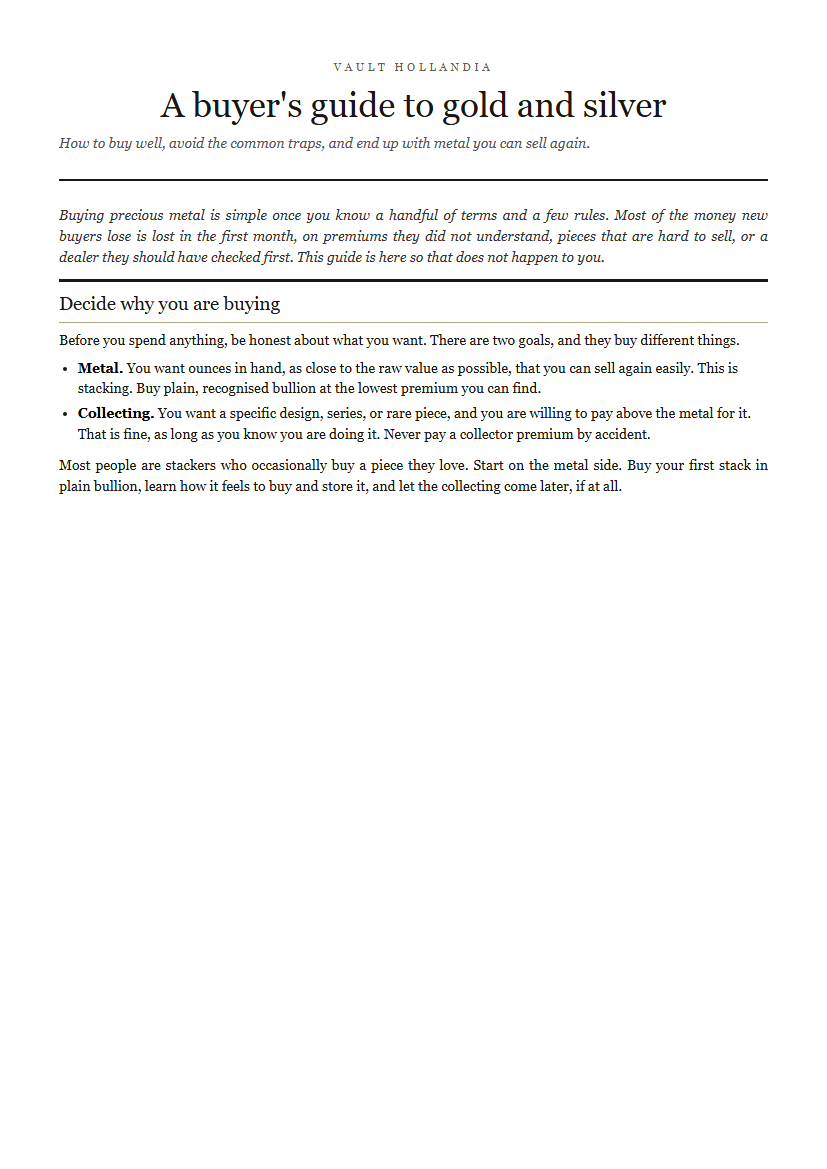
What this is: a few printed pages, no login and no app required to read it. Click the page to read the whole guide full size.
Who it is for: anyone buying gold or silver, whether it is your first coin or your fiftieth. It stays neutral: no dealer to push, nothing to sell you.
It pairs with the seller guide. This one is about buying well; the seller guide for relatives is about selling well when the time comes.
Decide why you are buying
Before you spend anything, be honest about what you want. There are two goals, and they buy different things.
- Metal. You want ounces in hand, as close to the raw value as possible, that you can sell again easily. This is stacking. Buy plain, recognised bullion at the lowest premium you can find.
- Collecting. You want a specific design, series, or rare piece, and you are willing to pay above the metal for it. That is fine, as long as you know you are doing it. Never pay a collector premium by accident.
Most people are stackers who occasionally buy a piece they love. Start on the metal side. Buy your first stack in plain bullion, learn how it feels to buy and store it, and let the collecting come later, if at all.
The words you need to know
These are the terms that decide whether you paid a fair price.
- Spot price: the live market price of the raw metal, quoted per troy ounce. It is your baseline. You can check it on our price calculator before you buy.
- Premium: everything you pay above spot. It covers minting, the dealer's margin, and, on some pieces, demand or rarity. The premium is where you win or lose. Compare it, do not just look at the total.
- Spread: the gap between what a dealer sells a piece for and what they will pay to buy it back. A wide spread means you start further underwater. Recognised bullion has the tightest spreads.
- Troy ounce: the standard weight for precious metals. One troy ounce is about 31.1 grams, a little heavier than a normal ounce.
- Fineness: the purity, written as a number like .999 or .9999, or as 995 and up for investment gold. Higher is not always better value, but it tells you exactly how much metal you are getting.
- Numismatic value: extra value from rarity, age, condition, or collector demand, separate from the metal. Great for collectors, a trap for stackers who pay it without meaning to.
- Secondary market: pieces being resold rather than sold new. The minting cost was already paid by someone else, so the premium is usually lower. Often the best value if you do not mind a piece that is not brand new.
- Recognised bullion: coins from national mints and bars from listed refiners that any dealer in the world will know on sight. Easy to buy, easy to check, easy to sell.
What you actually pay
The headline price is spot plus premium. Two pieces of the same weight can carry very different premiums, and over many purchases that difference is real metal you did or did not get to keep.
- Small pieces cost more per ounce. A tenth-ounce coin carries a much higher premium, as a percentage, than a one-ounce coin or a larger bar. Fractional sizes are useful, but you pay for the convenience.
- Bars are usually cheaper than coins, rounds sit in between. If you only want ounces, listed-refiner bars and plain rounds give you the most metal for your money. Government coins cost a little more but are the easiest to sell.
- The secondary market is often the best deal. Resold bullion at a discount to new is hard to beat for a pure stacker.
- Coin shows and local dealers can beat online prices with no shipping, and you can inspect the piece in your hand before you pay.
Choosing a dealer you can trust
Most of your safety comes from who you buy from. A good dealer makes fakes and bad prices almost impossible to walk into.
- Established and traceable. A real trading history, a physical address, a company name you can look up, and a phone number that a person answers.
- Transparent pricing. They show spot and the premium separately, with no vague "call for price" or fees that only appear at checkout.
- They buy back. A dealer who will quote you a buy-back price is a dealer who stands behind what they sell.
- Independent reviews. Not the testimonials on their own site. Look on review platforms and in the collector communities listed at the end of this guide.
- Recognised standing. Membership of a trade body, authorised-purchaser status with a national mint, or bars from refiners on the LBMA Good Delivery list are all good signs.
Walk away from pressure. A "today only" price, a cold call or message you did not ask for, a push toward "rare" or "exclusive" coins at many times their metal value, or a promise of guaranteed gains. Real metal does not need any of it. The hard sell is the scam.
What to buy first
Your first job is not to find a bargain. It is to buy pieces you will be able to sell again without explaining what they are. Liquidity first, cleverness later.
- Stick to the well-known names. Silver and gold from national mints, and bars from listed refiners such as Argor-Heraeus, Valcambi, Heraeus, or PAMP. If a dealer anywhere would know it on sight, it will be easy to sell.
- Sovereign coins are the easy default. A sovereign, or legal-tender, coin is struck by or for a government and carries an official face value, so dealers everywhere recognise it and it sells fast. The British Gold Sovereign is the classic: small, hard-wearing, and trusted by stackers for over a century, which is why it still changes hands so readily. The one-ounce national coins work the same way, among them the Maple Leaf, Britannia, Krugerrand, American Eagle, Philharmonic, and Kangaroo. They cost a little more than a plain bar or round, and for a first stack that liquidity is usually worth it.
- Keep sizes standard and small. One-ounce coins and bars, and standard bar weights, sell faster than odd or very large sizes. A single large bar is harder to sell in part when you need to.
- Do not marry one series. A themed collection is fun, but buying only one mint or one design limits who will want it later. Spread across a few recognised products.
- Buy the metal, not the story. For a first stack, ignore proofs, coloured editions, and limited runs. They cost more and most of that extra is not metal.
Check it is real
Buying from a reputable dealer is your best protection, by a wide margin. If you buy privately or second-hand, learn the simple checks. None of these damage the piece.
- Weight and size. A digital scale and a cheap set of calipers catch most fakes on their own. Every genuine coin and bar is struck to an exact weight, diameter, and thickness. Any deviation is a red flag.
- Magnet test. Gold and silver are not magnetic. A strong magnet should slide off slowly, never stick. Sticking means base metal inside.
- Ping test. Tapped, a real silver coin rings with a long, clear tone. A fake gives a dull, short thud. Once you have heard the real ring you will not forget it.
- An electronic verifier such as a Sigma reads the metal through the plastic and is the closest thing to certainty. Many coin shops have one and will test a piece on request.
- Keep the assay card or capsule. Bars in sealed assay cards and coins in their capsules are easier to sell and to trust. For a high-value collector coin, a piece already graded and sealed by a recognised grading service takes the guesswork away.
Paying and taking delivery
- Cheaper payment is worth using. Many dealers give a small discount for a bank transfer and add a fee for cards. On repeat buys that adds up.
- On a private sale, use protected payment. Pay through the platform's protected route where one exists. Be wary of any seller who insists on gift cards, crypto to a stranger, or a method with no recourse.
- Insured, tracked shipping only. For anything of value, both when it comes to you and if you ever ship it on.
- Inspect on arrival. Check the piece against what you ordered, weigh it, and run the quick tests above before the piece leaves your sight. Film the unboxing for higher-value orders.
Tax on what you buy
Tax can quietly turn a good price into a poor one, and it treats gold and silver differently. The rules vary a lot from one country to the next and change over time, so treat this as a checklist, not gospel, and confirm what applies where you live and where you buy.
- Gold is usually taxed more gently than silver. In many countries investment-grade gold, meaning bars and qualifying coins above a set fineness, is free of sales tax, while silver is not. That can make gold cheaper to hold than its premium alone suggests.
- Silver often carries the tax that gold escapes. Where a sales tax applies, it usually lands on silver. Work it into the real cost per ounce before you compare silver with gold, or before you compare one dealer with another across a border.
- Some coins are tax-advantaged at home. Certain government coins are free of capital gains tax for residents of the country that issues them, and second-hand or older coins are sometimes taxed more lightly than brand-new ones. Both are worth checking for the pieces you buy.
- Bonded storage can defer the tax. In some places you can hold metal free of sales tax by leaving it in a secure vault or free zone rather than taking it home. That saves the tax but costs you having it in your hand, which is the whole point for many buyers. Weigh the trade honestly.
This is general information, not tax advice. For anything involving a large sum or your own tax position, ask a qualified adviser.
Timing and how much
Nobody times the metal market reliably, and trying to is how beginners end up sitting in cash waiting for a dip that does not come.
- Buy on a schedule. A fixed amount every month, regardless of price, smooths out the highs and lows and takes the emotion out of it. This is dollar-cost averaging, and it beats guessing.
- Treat a dip as a bonus, not a plan. If the price falls and you have spare cash, buy more. But do not stop your regular buying to wait for one.
- Only buy what you can sit on. Metal is a long hold, not next month's rent. Common guidance is to keep it to a slice of your savings, not all of it.
Storage, security and privacy
- Decide where it lives before it arrives. A good home safe that is bolted down and hidden, a bank safe-deposit box, or insured third-party vaulting. Each trades convenience against security and cost.
- Handle it as little as possible. Hold coins by the edge, never the face. Skin oils and a stray wipe leave marks that cost real money on resale. Keep pieces in their capsules or cards, away from damp.
- Keep it quiet. The fewer people who know what you hold and where, the safer you are. There is never a reason to post your stack with anything that shows where you live.
- Insure the larger holdings and keep your records somewhere separate from the metal.
Keep a record from day one
Write down every purchase as you make it: the piece, its weight and purity, what you paid, the premium, the date, and a photo. It takes a minute and it saves you every time after. You will know your real average cost, you will have proof for insurance, and if the collection ever passes to family they will know exactly what they are holding instead of guessing at its weight.
This is what Vault Hollandia is for. It keeps that record encrypted on your own device, and it can produce a plain guide for your relatives so they can sell it well if they ever have to.
Where to learn and ask
You do not have to work it out alone. The collector communities are full of people who were beginners once and are happy to help you identify a piece, sense-check a price, or vet a dealer.
- Reddit: r/Silverbugs, r/silverstacking, r/Gold, and r/Pmsforsale for buying and selling between members.
- Forums such as The Silver Forum, where longer discussions and dealer reputations live.
- Dealer guides and videos can teach the basics well, but remember the seller wants a sale. Cross-check anything that sounds like a pitch against a neutral community.
- Compare before every buy. Check the same piece across a few dealers and against spot. Sold prices tell you more than asking prices.
Take your time. Start plain, buy recognised metal at a fair premium, keep a record, and let the collection grow at its own pace. The best buyers are patient, and patience is free.
This guide is general information, not financial, tax, or legal advice. Metal prices, dealer premiums, and tax rules vary by country and can change without notice. For anything touching a significant sum or your own tax position, speak with a qualified professional before you act.
